SAP Cloud ERP for Midmarket Growth: What the Data Actually Says
Midsize companies want growth, but legacy processes and fragmented data can become the constraint. The evidence points to Cloud ERP as an operating-model decision, not a hosting decision.
The midmarket growth problem is increasingly a systems problem
Midsize companies are often told that they have an agility advantage over large enterprises. That can be true while the organization is simple. Growth changes the equation. More customers, products, legal entities, locations and channels create coordination costs. Processes that worked through spreadsheets, personal knowledge and manual intervention begin to slow the company down.
The Oxford Economics and SAP study behind this article surveyed 2,100 executives in 30 countries, with fieldwork conducted in October and November 2023. Its results should therefore be read as a substantial international benchmark, not as a real-time 2026 market poll. Even with that caution, the pattern is highly relevant: executives want growth, but their systems, talent and operating models are not always ready to scale with it.
Thirty-nine percent of respondents selected attracting new customers as a top two-year objective, 38% selected increasing market share and 38% selected growing revenue. At the same time, 57% identified the inability to scale processes and systems with organic growth as a major IT challenge. Forty-six percent pointed to manual, low-value workarounds caused by legacy-system deficiencies.
That is the core executive issue: growth creates value only when the operating model can absorb it.
Four findings that should shape a Cloud ERP decision
1. Growth priorities are clear, but enabling priorities are weaker
The study shows strong focus on customers, market share, revenue and margins. Employee productivity and talent attraction ranked lower as strategic objectives even though skills and talent were among the most frequently cited risks. This is a classic execution gap. Leadership teams prioritize outcomes while underweighting the capabilities required to deliver them.
A Cloud ERP program should therefore not be framed only as a finance or IT replacement. It should be linked to the capacity of the business to onboard people, standardize work, open new locations, launch products and maintain control as transaction volumes rise.
2. Scalability is more than infrastructure
When executives say they cannot scale, they are not only describing server capacity. They are describing processes, decisions, data, roles and manual handovers. The report found that 47% struggled to adjust or replan when new information emerged, creating delayed delivery and customer dissatisfaction. Forty-six percent cited difficulty establishing new businesses, entering geographies or deploying new business models.
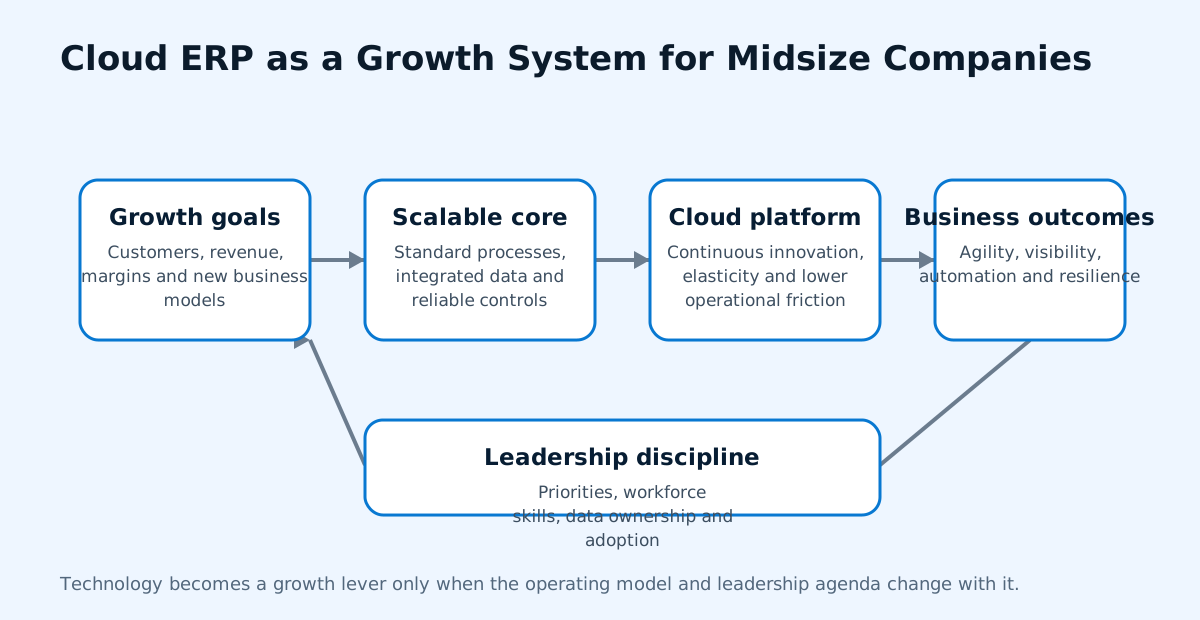
Cloud infrastructure can provide elasticity, but the deeper benefit comes from a scalable operating model: standardized processes, integrated data, repeatable controls and an architecture that can absorb change without another large customization project.
3. Data integration is a growth capability
Eighty-three percent of respondents said data integration was critical to creating innovative business models at scale. Seventy-six percent linked it to accelerating digital transformation and 74% to knowledge generation for continuous innovation.
Those figures make a simple point. ERP is not valuable because it stores transactions. It is valuable because transactions become reliable inputs for decisions across finance, supply chain, procurement, workforce and customer operations. When data remains fragmented, growth creates more reconciliation rather than more insight.
4. Cloud adoption produces operational benefits, but not automatically
Among reported benefits of cloud adoption, 40.9% cited improved agility, 39.2% process optimization and 35.2% cost reduction. Nearly three-quarters of respondents had adopted cloud solutions. The top-performing segment was also more likely to have ERP in place: 70% of leaders compared with 54% of laggards.
Correlation is not causation. The study does not prove that ERP or cloud adoption alone created superior financial performance. Stronger companies may simply be better at investing and executing. The useful conclusion is more disciplined: top performers are more likely to combine growth ambition, integrated data, established ERP and cloud readiness.
Why SAP Cloud ERP can fit the midmarket growth agenda
SAP Cloud ERP can provide a standardized transactional core across finance, procurement, sales, inventory, supply chain and other processes. For midsize organizations, the strategic attraction is not “enterprise software for smaller companies.” It is the ability to adopt an operating model that is designed to scale without recreating every legacy variation.
The strongest case typically exists when a company has one or more of the following conditions:
- rapid organic growth is exposing manual workarounds;
- multiple entities or locations use inconsistent processes;
- management reporting depends on spreadsheet consolidation;
- the business wants to enter new countries or launch new models quickly;
- scarce experts are spending time maintaining infrastructure and custom code;
- acquisitions require a repeatable integration template;
- AI and analytics ambitions are blocked by fragmented transactional data.
The weakest case is “move to cloud because cloud is the strategy.” A Cloud ERP program should have a measurable business thesis.
The standardization question
Public Cloud ERP creates value through standardization and continuous innovation. That same standardization can feel restrictive to teams that are used to designing software around every local preference.
The executive decision is not standard versus flexibility in the abstract. It is where differentiation genuinely matters.
A practical model divides processes into three groups:
Differentiate
These are capabilities that create a customer, product or operating advantage. They may require extensions, specialized applications or unique data and AI models.
Standardize
These are processes where consistency, control and low cost matter more than uniqueness. Examples often include core accounting, standard procurement controls, basic order management and common master-data processes.
Simplify or stop
These are historical activities that exist because the old system or organization required them. A transformation should remove them rather than reproduce them.
This classification is essential for a fit-to-standard program. Without it, every requirement is treated as strategic and the cloud core is gradually rebuilt into another customized legacy environment.
A four-part executive decision framework
1. Growth model
What kind of growth must the platform support: more volume, more locations, more legal entities, acquisitions, new channels or new services? Each growth model creates different requirements.
2. Operating-model readiness
Does leadership genuinely support standardization? Are process owners empowered to make cross-functional decisions? Can local teams accept global templates? Technology cannot compensate for unresolved governance.
3. Data and integration architecture
Which data must remain in the core, which belongs in a business data platform and which external systems must be integrated? Cloud ERP should simplify the core while creating clean interfaces to the wider landscape.
4. Value and adoption plan
Which outcomes will improve and how will they be measured? Examples include faster close, lower manual effort, shorter order cycle, faster site rollout, better inventory visibility or reduced IT operations effort. Adoption metrics should be connected to those outcomes.
What the research says about technology investment and growth
The study’s macroeconomic analysis found that digital spending in major advanced economies had grown faster than other technology spending over the prior decade. Its regression analysis suggested that midsize sectors were more sensitive to reductions in digital investment than larger-company sectors. A 10% reduction relative to expected software, IT services and internet/cloud spending was associated with a lower average annual sales-growth rate in the analyzed period, with a stronger effect in sectors with more midsize companies.
This is not a promise that spending more will create growth. Wasteful programs remain wasteful. The management insight is that underinvestment in the digital operating core can constrain growth precisely when the business needs capacity and speed.
A pragmatic Cloud ERP roadmap for a midsize company
Phase 1: Define the growth case
Link the program to two or three strategic outcomes. Avoid a long list of generic benefits. Establish baseline measures and identify the processes that currently limit growth.
Phase 2: Design the standard core
Run fit-to-standard workshops with empowered business owners. Classify requirements as differentiate, standardize or stop. Define clean extension and integration principles before design decisions accumulate.
Phase 3: Deliver a controlled first scope
Choose a scope that proves the template: a legal entity, region or end-to-end process with visible business value. Protect the timeline by preventing low-value customization from entering the core.
Phase 4: Scale through repeatability
Use the first implementation as a rollout model. Standardize data migration, testing, training, cutover and support. Growth is supported when the next entity is easier than the first.
The leadership lesson from the “leaders versus laggards” comparison
The top-performing organizations in the research were not defined by one technology. They combined commercial ambition with data integration, ERP adoption, cloud readiness and international focus.
The lesson for the midmarket is not to copy a product list. It is to build a coherent system for growth. Cloud ERP is one component of that system, but it becomes strategic when it reduces coordination cost and gives leaders a more reliable way to scale decisions, controls and execution.
Executive takeaway
The decision is not whether to adopt another technology label. The decision is whether the operating model, architecture, governance and value case are strong enough to turn the technology into repeatable business outcomes. That is the standard sapperment applies: separate the vendor promise from the management decision, and make the path to execution explicit.
Frequently asked questions
Is Cloud ERP only suitable for large enterprises?
No. The strategic case can be especially strong for midsize companies whose growth is creating process fragmentation, manual work and inconsistent controls across entities, locations or channels.
Does the Oxford Economics study prove that Cloud ERP causes growth?
No. It shows associations between top performance, ERP presence, cloud adoption and data integration. It does not establish that technology alone caused superior growth or profitability.
What is the biggest Cloud ERP risk for a midsize company?
Recreating legacy complexity in the cloud. If every local preference becomes a requirement, the company loses the speed, standardization and upgrade benefits that support the business case.
How should a company choose between public and private cloud ERP?
The decision should reflect process standardization, customization requirements, regulatory constraints, transformation approach and operating-model readiness—not company size alone.
Which metrics should be included in the business case?
Use business measures such as close duration, manual effort, order cycle time, inventory visibility, site-rollout speed, data-reconciliation effort and IT operations cost.
Related reading and internal links
- Executive Clarity
- SAP Cloud ERP for Finance
- Autonomous Enterprise operating model
- SAP BW modernization in Business Data Cloud
- The SAP skills gap
- RISE vs GROW — an executive decision framework
- Andreas BORN — executive author profile
Call to action
Use this article as an executive briefing before your next architecture, transformation or investment decision. For board-level framing, transformation challenge sessions and independent decision support, visit Executive Clarity.
Sources and evidence
- Oxford Economics and SAP, “Four Ways to Compete in a Fast-Changing World,” survey of 2,100 executives in 30 countries; fielded October–November 2023. See especially pages 3–10.
- The report’s page 4 charts show 57% citing inability to scale processes and systems and 46% citing manual workarounds from legacy-system deficiencies.
- The report’s page 7 highlights 83% agreement on the importance of data integration and summarizes reported cloud-adoption benefits.
- The report’s page 8 compares top-performing midsize leaders with laggards, including ERP presence and cloud adoption.
Source integrity note
The Oxford Economics study was fielded in 2023. This article preserves its dates and treats the results as a benchmark rather than current 2026 market data. Statistical relationships are not presented as proof of causation.