SAP Cloud ERP for Finance: Buyer Evidence on ROI, Scalability, and Control
SAP Cloud ERP receives strong buyer ratings for finance, but the CFO decision must go beyond feature scores to measurable outcomes in close, cash, working capital, controls and scalability.
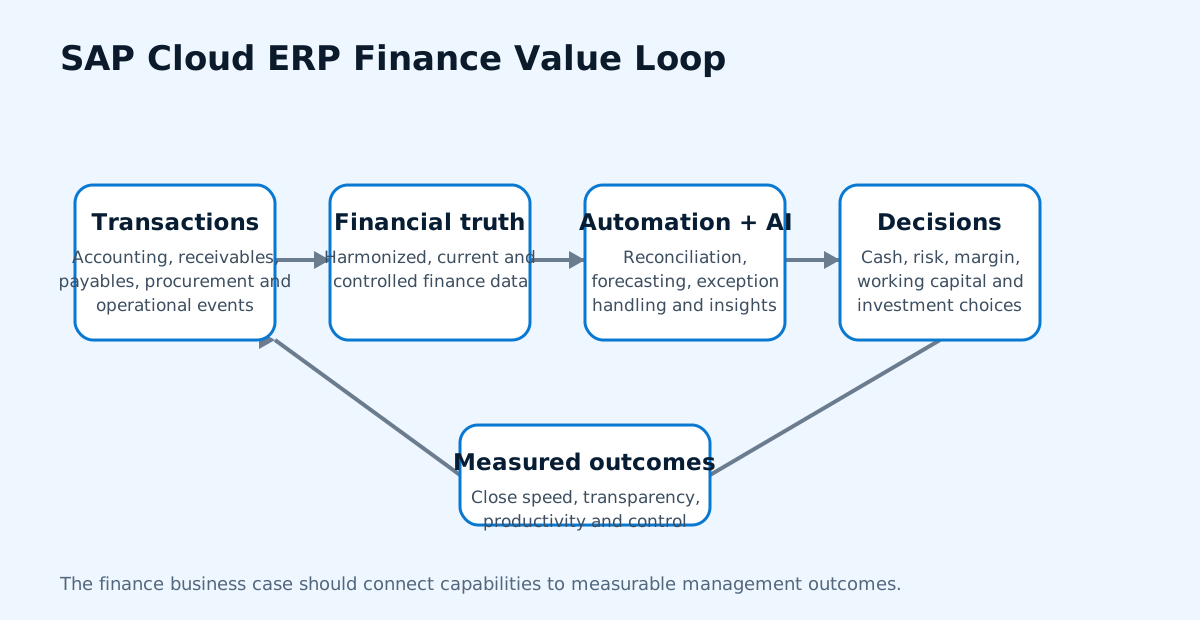
Finance is where Cloud ERP promises become measurable
ERP discussions often begin with architecture and end with broad claims about transformation. Finance provides a harder test. Does the platform shorten the close? Improve cash visibility? Reduce manual reconciliation? Strengthen controls? Help the organization make decisions with current rather than delayed information?
The TrustRadius market report used for this article was produced in September 2025 from TrustRadius reviews and data. It is a useful buyer-evidence source, but it requires context. The report is SAP-branded, and several quoted reviews are marked “incentivized.” The results should not be treated as an independent audit of customer value. They should be treated as signals that executives can test during their own evaluation.
With that caveat, the evidence is strong enough to shape the questions a CFO should ask.
What the buyer evidence says
The report gives SAP Cloud ERP a TrustRadius trScore of 8.5 out of 10, compared with an ERP category average of 7.5. Its summary page reports that:
- 96% of reviewed buyers would purchase again;
- 95% were satisfied with the feature set;
- 86% said implementation proceeded as expected;
- 96% said the solution offered good value for price;
- 89% said sales and marketing promises were fulfilled.
These are encouraging indicators, but they are not a substitute for understanding the sample, implementation scope, review incentives and customer context. A buyer should ask how many reviews support each percentage, which product editions were included and how similar the reviewers are to the planned deployment.
The report also compares selected finance capabilities with category averages. It lists credit-card processing at 8.8 versus 6.9, accounts receivable at 8.2 versus 7.7, cost of goods sold at 8.2 versus 8.0, accounts payable at 8.2 versus 7.7 and integrated requirements-to-order capability at 8.1 versus 6.7.
The important point is not the ranking by itself. It is the breadth of the finance operating model: transactions, receivables, payables, cost, procurement and reporting are connected rather than optimized as separate tools.
The CFO value case has four layers
1. A current and controlled financial truth
A finance organization cannot move faster if it spends its time reconciling versions of reality. SAP’s current product positioning emphasizes a single source of truth across financial data and processes, including support for different accounting principles and real-time ledger views.
The executive question is not whether the system contains one database. It is whether the finance organization has agreed definitions, ownership and controls across entities, ledgers, profit centers, customers, suppliers and products.
2. Automation of high-volume finance work
Cloud ERP can automate postings, allocations, workflow, reconciliation and exception handling. The value appears when automation reduces effort and variation without weakening control.
A useful business case separates three types of work:
- straight-through work that can be executed automatically;
- exception work that requires investigation or approval;
- judgment work that requires senior finance expertise.
The goal is not automation for its own sake. It is to move finance capacity from repetitive coordination toward analysis, decisions and business partnership.
3. Better working-capital and risk decisions
Finance operations are not only back-office processes. Receivables, payables, cash and credit decisions directly affect growth and resilience. Current SAP material highlights visibility into cash position and forecast, management of receivables and disputes, and risk mitigation.
A strong value case connects platform capabilities to metrics such as days sales outstanding, overdue receivables, dispute cycle time, cash-forecast accuracy, payment cost and bad-debt exposure.
4. A scalable finance model
Several reviews in the TrustRadius report describe SAP Cloud ERP as the platform that supports multiple locations and integrates finance with supply chain, procurement and production. That is strategically important for organizations that are expanding, acquiring businesses or operating across jurisdictions.
Scalability should be measured in operating terms: how quickly can a new entity be onboarded, a new accounting requirement be supported, a policy be applied consistently or a management view be produced?
What reviewers valued—and what executives should verify
The report’s qualitative reviews repeatedly mention detailed reporting, configurable layouts, large-volume data processing, faster close, Fiori usability, statutory reporting and integration across functions.
Each of those positives creates a due-diligence question.
“Detailed reporting”
Verify which reports are delivered, which require configuration, which require SAP Analytics Cloud or other services and how custom management reporting will be governed.
“Configurable layouts”
Determine whether configuration remains upgrade-safe and whether local flexibility will create reporting inconsistency.
“Faster close”
Identify the specific bottlenecks to be removed: intercompany reconciliation, accruals, allocations, data collection, consolidation or approval. A platform cannot shorten a close if the process and ownership remain unchanged.
“Large data volumes”
Test representative transaction and reporting loads. Evaluate archiving, data lifecycle, integration latency and the cost of retained data.
“Integrated processes”
Map the end-to-end process, not only the finance step. An automated invoice process still fails if purchase-order quality, goods receipt or master data remain weak.
The finance transformation sequence
Step 1: Define the management outcomes
Select a small number of measurable outcomes: reduce close duration, improve cash visibility, lower reconciliation effort, standardize controls, improve forecast accuracy or accelerate entity onboarding.
Step 2: Establish the finance data model
Define the chart of accounts, ledgers, organizational structures, master-data ownership and reporting dimensions. These decisions are harder to change later than most configuration choices.
Step 3: Standardize the process before automating it
Remove unnecessary local variants. Decide where policy must be global and where legal requirements justify variation. Automation scales good process and bad process equally well.
Step 4: Design controls into the workflow
Clarify segregation of duties, approvals, audit evidence, exception thresholds and monitoring. Controls should be part of the process model, not a parallel compliance layer.
Step 5: Connect finance to operations
The value of Cloud ERP rises when finance is linked to sales, procurement, inventory, production and supply chain events. This enables management to understand not only what changed financially, but which operational event drove the change.
Step 6: Measure value after go-live
Track the baseline and actual result. A project can be technically successful while the finance outcome remains unchanged. Benefits should have named owners and a review cadence.
Where AI fits in finance
SAP positions AI-driven finance around forecasting, recommendations, reconciliation and decision support. The Autonomous Enterprise direction goes further: assistants and agents can coordinate routine work and execute approved actions across processes.
The adoption sequence should remain disciplined.
- Begin with high-volume, well-understood work.
- Use trusted finance data and explicit accounting rules.
- Keep material judgments and policy decisions under human control.
- Log the evidence behind recommendations and actions.
- Measure error rates, override rates and realized business outcomes.
The quality of finance AI will be limited by the quality of financial definitions and process governance. A sophisticated model does not compensate for disputed master data or unclear ownership.
The CFO evaluation scorecard
A product demonstration should be converted into a decision scorecard across six areas:
- Business outcomes: close, cash, working capital, reporting and productivity.
- Process fit: standard coverage, exceptions and required extensions.
- Data model: organizational structures, master data and reporting semantics.
- Controls: authorization, auditability, compliance and segregation of duties.
- Integration: upstream operational data and downstream analytics, tax, treasury or consolidation services.
- Economics: subscription, implementation, transition overlap, integration, support and expected benefit.
A high review score is useful evidence. A finance transformation still succeeds or fails on these six dimensions.
The central conclusion
SAP Cloud ERP for Finance should not be purchased as a collection of features. It should be selected as a management system for financial truth, controlled execution and scalable decision-making.
The buyer evidence suggests that many users value the platform’s breadth, integration and finance capabilities. The executive task is to translate those signals into a specific business case, test them against the planned edition and scope, and maintain the discipline to standardize the operating model rather than reproducing the past in a new environment.
Executive takeaway
The decision is not whether to adopt another technology label. The decision is whether the operating model, architecture, governance and value case are strong enough to turn the technology into repeatable business outcomes. That is the standard sapperment applies: separate the vendor promise from the management decision, and make the path to execution explicit.
Frequently asked questions
What TrustRadius score did SAP Cloud ERP receive in the source report?
The September 2025 report lists a trScore of 8.5 out of 10, compared with an ERP category average of 7.5.
Are the TrustRadius results independent customer proof?
They are useful buyer evidence, but not an independent audit. The report is SAP-branded and several reviews are labeled incentivized, so executives should validate the sample and test the claims in their own context.
Which finance outcomes should be measured?
Common measures include close duration, reconciliation effort, cash-forecast accuracy, days sales outstanding, dispute cycle time, manual journal volume, control exceptions and entity-onboarding time.
Does Cloud ERP automatically create a faster close?
No. The platform can enable automation and real-time data, but the close improves only when process design, ownership, master data, integrations and controls are also improved.
Where should AI be introduced first in finance?
Start with high-volume, rules-based areas such as reconciliation, exception detection, forecasting support and workflow coordination, while retaining human judgment for material decisions and policy exceptions.
Related reading and internal links
- Executive Clarity
- SAP Cloud ERP for midmarket growth
- Autonomous Enterprise operating model
- SAP Snowflake and SAP Business Data Cloud
- Faster close — month-end as the honest ERP benchmark
- ERP ROI — evidence over folklore
- Andreas BORN — executive author profile
Call to action
Use this article as an executive briefing before your next architecture, transformation or investment decision. For board-level framing, transformation challenge sessions and independent decision support, visit Executive Clarity.
Sources and evidence
- TrustRadius and SAP, “SAP Cloud ERP Marktbericht – Finanzen,” September 2025, pages 1–6. The report includes trScore, feature comparisons, buyer summaries and review-based percentages.
- SAP, “SAP Cloud ERP | Finance.” https://www.sap.com/products/erp/s4hana/features/finance.html
- Source-page note: several reviews in the TrustRadius report are explicitly marked “Incentivized.”
Source integrity note
The TrustRadius report is vendor-branded and contains incentivized reviews. The article uses the published figures accurately while adding explicit due-diligence caveats and avoiding claims that the report does not support.