Autonomous Enterprise: Why Enterprise AI Needs a New Operating Model
Enterprise AI will not scale through more pilots alone. It needs shared business context, trusted data, embedded governance and a new division of work between people, assistants and agents.
The real enterprise AI problem is not model quality
Most executive discussions about enterprise AI still start with tools: Which model? Which copilot? Which agent platform? Those questions matter, but they are rarely the reason enterprise initiatives stall. The larger obstacle is structural. A pilot can work inside one team because the scope is controlled, the data is known and people compensate manually for missing links. The same design often fails when it has to cross finance, supply chain, procurement, human resources and customer operations.
The SAP executive guide used for this article makes the point directly: many organizations are not suffering from a lack of AI. They are suffering because AI is not integrated deeply enough into the way the business operates. Local productivity gains do not automatically become enterprise transformation. A document can be summarized faster, a forecast can be produced more quickly and a service agent can receive a better recommendation, yet the end-to-end process can remain slow because decisions still wait for manual handovers, reconciliation and approval.
That distinction matters for boards and transformation leaders. AI as a feature improves a task. AI as an operating model changes how the company senses, decides and acts.
Why successful AI pilots do not scale automatically
Four failure patterns appear repeatedly.
1. Local optimization without end-to-end redesign
A team automates one step but leaves the upstream and downstream process untouched. The result is a faster island inside the same slow chain. Finance still waits for source data, supply chain still reconciles different versions of demand and procurement still follows a separate exception process.
2. Fragmented data and inconsistent meaning
Enterprise systems contain more than values in fields. They contain business meaning: which customer hierarchy applies, how a material is classified, which ledger is authoritative, which policy controls an approval and which exception requires human intervention. AI can process technically available data and still produce a weak business outcome when the semantics are inconsistent.
3. Governance added after the pilot
Pilots are often designed to prove possibility. Production environments must prove reliability. That means identity, authorization, auditability, explanation, escalation and accountability cannot be added as a final workstream. They have to shape the design from the beginning.
4. Insight remains disconnected from execution
A dashboard highlights risk, but someone must notice it, interpret it, align with colleagues and trigger the next action. The delay between signal and action becomes the real bottleneck. Better insight alone does not remove that delay.
What an Autonomous Enterprise actually means
The phrase can sound like a promise of a company without people. That is the wrong interpretation. SAP defines the Autonomous Enterprise as a new operating model in which people set direction and AI executes within governed boundaries. Human judgment remains essential for strategy, policy, accountability, exceptions and decisions where context cannot be reduced to a rule.
The change is in the division of work.
- People define intent. Leaders set outcomes, priorities, risk tolerance and decision rights.
- Assistants coordinate. Role-aware assistants help users interact with processes through natural language and context-rich workflows.
- Agents execute. Specialized agents complete multi-step tasks, monitor conditions and coordinate actions across SAP and non-SAP systems.
- Governance controls the system. Permissions, policies, audit trails, approvals and human intervention are built into execution.
- The organization learns. Outcomes are measured and used to improve rules, data quality and process design.
This is why an Autonomous Enterprise is not a single product or implementation project. It is a direction for operating-model design.
The five layers executives need to align
Layer 1: Business intent
Every autonomous process needs a defined outcome. “Use AI in collections” is not an outcome. “Reduce overdue receivables while protecting strategic customer relationships and respecting credit policy” is. The clearer the outcome and constraints, the more useful automation becomes.
Layer 2: Process context
AI needs to understand the process it is acting within: the sequence of events, decision points, dependencies, service levels and exceptions. Process context prevents an agent from optimizing one metric while damaging another. A purchasing agent should not reduce unit cost by selecting a supplier that introduces unacceptable delivery or compliance risk.
Layer 3: Semantically trusted data
The source guide emphasizes semantically enriched business data. This is more demanding than integration alone. Data must carry meaning and relationships across customers, suppliers, materials, employees, assets and financial structures. A unified view is valuable only when everyone agrees what the view represents.
Layer 4: Governed intelligence
Models, assistants and agents need explicit controls. Which data may they use? Which actions can they take independently? Which decisions require approval? How are exceptions handled? What evidence is retained for audit? Governance should enable speed by making the permitted path clear, not merely slow the system through additional checkpoints.
Layer 5: Execution across systems
The final test is whether the system can act. That may mean updating a plan, opening a case, changing a purchase order, requesting approval, reallocating inventory or escalating a customer risk. An enterprise becomes more autonomous when insight and execution are connected across the full process, not when it produces more recommendations.
How the operating loop works
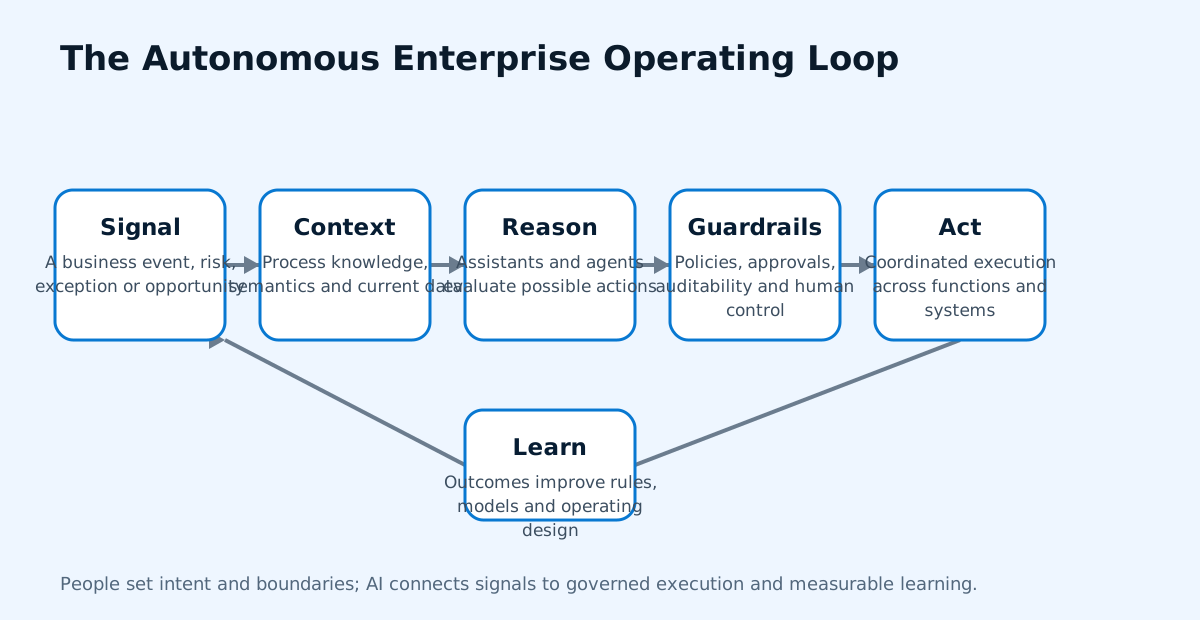
The original visual above reduces the model to six stages.
- Signal: A change occurs: demand shifts, a payment is late, a supplier risk rises or an employee skill gap emerges.
- Context: The signal is evaluated against current data, business semantics, process history and policy.
- Reason: An assistant or agent evaluates response options and likely consequences.
- Guardrails: The action is checked against authority, policy, risk and human-approval thresholds.
- Act: The approved response is coordinated across the relevant systems and functions.
- Learn: The result is measured and used to improve future decisions.
The loop is more important than any individual technology. Without it, organizations accumulate disconnected AI capabilities. With it, they build a repeatable mechanism for moving from intent to outcome.
What changes in the major business functions
Autonomous finance
Finance moves from periodic reporting toward continuous monitoring and guided action. AI can support reconciliations, detect anomalies, monitor working-capital signals and coordinate follow-up. The CFO still owns policy, material judgments and accountability, but the organization spends less time collecting and reconciling information.
Autonomous supply chain
A disruption should not stop at a dashboard. It should trigger coordinated analysis across demand, inventory, sourcing, production, transportation and finance. The system can propose or execute responses within approved boundaries while planners focus on trade-offs and strategic exceptions.
Autonomous spend
Sourcing, procurement, supplier management, invoicing and travel processes can share signals and controls. Routine coordination can be automated, while commercial and risk decisions remain visible and governed.
Autonomous HCM
Workforce planning, recruiting, skills and learning become more connected. AI can identify gaps and coordinate standard actions, while people leaders make decisions involving culture, potential, fairness and organizational design.
Autonomous customer experience
Customer signals from sales, service and commerce can be interpreted together. Agents can resolve routine issues and coordinate responses, while people concentrate on complex relationships and moments that require empathy or negotiation.
The board-level decision: where should autonomy begin?
Trying to transform every process at once is a reliable way to create another large program with unclear value. Start where five conditions are present:
- The process has a measurable business outcome.
- Delay or inconsistency creates material cost, risk or lost revenue.
- The process crosses functions or systems and therefore benefits from coordination.
- Data and decision rights are sufficiently understood to create guardrails.
- Human accountability can be designed explicitly.
Good starting points often include collections, supply-chain exceptions, invoice reconciliation, service resolution, procurement compliance and workforce-demand matching. The best first use case is not the most spectacular demonstration. It is the one that proves the operating loop.
A pragmatic 90-day executive agenda
Days 1–30: Choose the outcome and map the real process
Select one material process. Document the current signal-to-action time, manual handovers, data sources, decisions, policies and exceptions. Identify the economic value of reducing delay or variation.
Days 31–60: Design the governed operating loop
Define what AI may recommend, what it may execute, when human approval is required and how every action will be traced. Agree on data ownership and the semantic definitions that the process depends on.
Days 61–90: Prove execution, not just insight
Build the smallest end-to-end version that can detect a signal, use business context, apply guardrails, take a controlled action and measure the result. The success metric should be a business outcome such as cycle time, working capital, service level or exception reduction—not the number of prompts or agents deployed.
The most important management principle
Do not count AI use cases. Count governed decisions and completed outcomes.
An organization with fifty disconnected copilots may be less advanced than one with three end-to-end autonomous processes. The first has more technology. The second has changed how work gets done.
Executive takeaway
The decision is not whether to adopt another technology label. The decision is whether the operating model, architecture, governance and value case are strong enough to turn the technology into repeatable business outcomes. That is the standard sapperment applies: separate the vendor promise from the management decision, and make the path to execution explicit.
Frequently asked questions
Is an Autonomous Enterprise a company run without people?
No. People set strategy, policy, priorities and accountability. AI supports or executes defined work within explicit guardrails, with human intervention for exceptions and material judgments.
How is an Autonomous Enterprise different from traditional automation?
Traditional automation usually executes predefined steps. An Autonomous Enterprise continuously senses conditions, reasons with business context and coordinates governed action across end-to-end processes.
What is the biggest barrier to scaling enterprise AI?
The largest barrier is usually structural fragmentation: disconnected processes, inconsistent semantics, unclear decision rights and governance that was not designed into execution.
Where should a company start?
Start with one cross-functional process where delay, manual coordination or inconsistency has measurable economic impact and where decision rights can be made explicit.
How should success be measured?
Measure business outcomes such as cycle time, exception volume, working capital, service level, risk reduction and the percentage of actions completed within approved guardrails.
Related reading and internal links
- Executive Clarity
- SAP Business Data Cloud and BW modernization
- SAP Cloud ERP for Finance
- SAP Snowflake and SAP Business Data Cloud
- Autonomous Enterprise readiness — a self-assessment
- AI agents in ERP
- Embedded AI governance
- The insight-to-action gap
- Andreas BORN — executive author profile
Call to action
Use this article as an executive briefing before your next architecture, transformation or investment decision. For board-level framing, transformation challenge sessions and independent decision support, visit Executive Clarity.
Sources and evidence
- SAP source file: “Aufbruch in eine neue Ära: Ein Leitfaden zum Autonomous Enterprise für Führungskräfte,” especially pages 3–10 on scaling barriers, business context, governance and the people/AI division of work.
- SAP, “What is an Autonomous Enterprise?” https://www.sap.com/resources/what-is-an-autonomous-enterprise
- SAP, “Autonomous Enterprise.” https://www.sap.com/products/autonomous-enterprise.html
- SAP News Center, “SAP Unveils the Autonomous Enterprise,” 12 May 2026. https://news.sap.com/2026/05/sap-sapphire-sap-unveils-autonomous-enterprise/
Source integrity note
The source PDF is SAP-authored material. Product framing is distinguished from sapperment analysis. The article does not treat vendor vision as proof of realized customer outcomes; it translates the operating-model claims into an executive decision framework.