SAP CV Advice: How to Make Your Experience Stand Out
By Callum George · Featured Recruiter · Wolf Jansen
The answer is usually not a longer CV — it is a clearer one. A specialist SAP recruiter on the three things a strong SAP CV makes obvious in seconds: what you specialise in, what you delivered, what impact you had.
I see hundreds of SAP CVs every year, and one of the most common questions I get is:
“How do I make my CV stand out and actually land interviews?”
The answer is usually not to make it longer.
It is to make it clearer.
Hiring managers and recruiters are often reviewing a high number of profiles, and the strongest SAP CVs make it easy to understand three things quickly:
- What do you specialise in?
- What have you actually delivered?
- What impact have you had?
Your CV does not need to include every task you have ever completed. It needs to give the reader confidence that your experience is relevant, credible and worth discussing further.
Start with a clear professional summary
The top of your CV should immediately position you in the market.
Avoid vague introductions such as:
“Experienced IT professional with strong communication skills and a passion for technology.”
That could describe almost anyone.
Instead, be specific. For example:
“SAP S/4HANA Finance Consultant with 8 years’ experience delivering Finance transformation programmes across Germany and Europe, with particular expertise in FI, CO, S/4HANA and global template rollouts.”
In one sentence, I already know what you do.
Your summary should normally cover:
- your main SAP specialism;
- your level of experience;
- the type of projects you have worked on;
- any particularly valuable expertise;
- relevant industries or regions where useful.
Keep it short. The aim is not to tell your entire career story in the first paragraph. It is to give the reader a reason to continue.
Show achievements, not only responsibilities
This is one of the biggest areas where SAP CVs can improve.
A lot of candidates describe what they were responsible for. For example:
- “Responsible for SAP FI configuration.”
- “Supported month-end close.”
- “Worked on S/4HANA implementation.”
All of that may be true, but it does not show the impact of your work.
Where possible, turn responsibilities into achievements. For example:
- Reduced month-end close by 35% through process automation.
- Cut manual reconciliations by 40%.
- Delivered S/4HANA Finance across 12 countries.
- Led Fit-to-Standard workshops across multiple business units.
- Reduced custom development by moving processes closer to SAP standard.
Hiring managers want to know what changed because you were involved.
Not every achievement needs to include a percentage or financial figure. But if you can quantify scale, complexity or outcome, do it.
Numbers create credibility.
Keep your skills section short and relevant
A good skills section should help someone scan your profile in seconds. It should not be a list of every SAP technology you have ever seen.
If you are an SAP Finance consultant, focus on your genuine core areas. For example: SAP FI · SAP CO · S/4HANA Finance · Accounts Payable · Accounts Receivable · Asset Accounting · Financial Closing · Data Migration · Fit-to-Standard · Integration with SD/MM.
If you touched SAP Ariba for two weeks five years ago, it probably does not need to be presented as a core skill.
The same applies to soft skills. “Team player”, “hard-working” and “good communicator” add very little. Your experience should prove those things.
Make your experience tell a story
Your work experience is the most important part of the CV. Do not turn it into a long list of generic tasks.
Each role should help the reader understand:
- What was the environment?
- What were you responsible for?
- What did you deliver?
- Where did you personally add value?
If possible, include enough project context to make the experience meaningful. Was it a greenfield implementation? A rollout? A brownfield conversion? Public Cloud or Private Cloud? How many countries were involved? What was your role in the programme? Which project phases did you cover?
This is particularly important in SAP because job titles can be misleading. Two people might both be called “Senior SAP Consultant”, while one has led global design across 15 countries and the other has mainly worked in support.
The detail tells the real story.
Make your own contribution clear
This is something I look for both on CVs and in interviews.
Be careful with the word “we.”
“We implemented S/4HANA.” “We designed the global template.” “We completed the rollout.”
That explains what the project did. It does not explain what you did.
Use wording that makes your own contribution obvious. For example:
“Led the Finance design workshops and owned the Accounts Payable process for the global template.”
Or:
“Coordinated testing across six countries and managed the resolution of Finance-related defects before go-live.”
You do not need to pretend you delivered the whole project alone. But the hiring manager needs to understand your level of responsibility.
Prioritise recent and relevant experience
Your CV does not need to give equal space to every stage of your career.
If you have worked in SAP for 15 years, the project you completed in 2011 probably does not need the same level of detail as the S/4HANA transformation you completed last year.
Give the most space to the experience that is most relevant to where you want to go next. This is especially important when moving into newer areas such as S/4HANA Cloud, BTP or Clean Core.
Make that experience easy to find. Do not bury your strongest project halfway down page four.
Keep the design professional and easy to scan
A strong CV does not need an elaborate design. It needs to be easy to read.
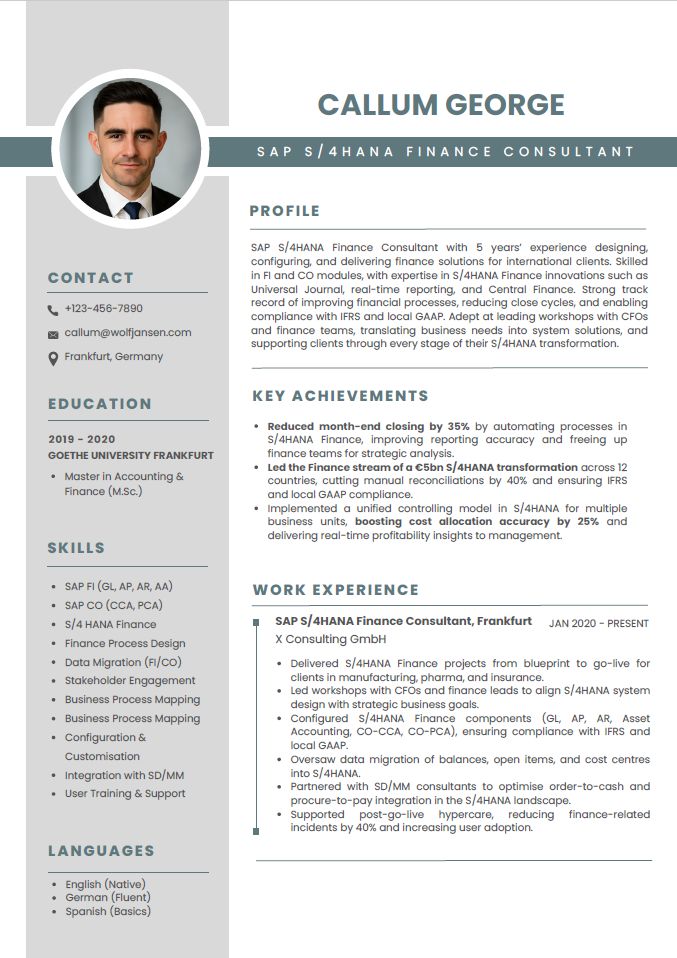
Use clear sections such as: Profile · Key Skills · Key Achievements · Professional Experience · Education & Certifications · Languages.
Avoid huge blocks of text. Use bullet points. Keep formatting consistent. And make sure important information can be found quickly.
The example format I often recommend puts the professional summary, achievements, key skills and experience in clear sections so the reader can immediately understand the candidate’s profile:
The goal is not to tell everything
Your CV has one main purpose. To get you into the interview.
You do not need to explain every detail of every project. You need enough information to create interest and prove credibility.
The best SAP CVs are not necessarily the longest or the most technical. They are the ones that make it easy for someone to understand:
- What you specialise in.
- What you have delivered.
- How much responsibility you had.
- What impact you made.
Be specific. Be relevant. Show outcomes.
And make your strongest experience impossible to miss.
Callum George is Team Lead, SAP Recruitment at Wolf Jansen and a Featured Recruiter in the sapperment Talent Network — he signed the Recruiting Charter. He writes here in a personal capacity; views are his own.
Next steps: once the CV lands the interview, his companion piece shows how to win it — How to Turn Project Experience into Evidence · know what the role should pay with Know Your Worth · or see the verified SAP roles open now.