SAP Snowflake and SAP Business Data Cloud: How Zero-Copy Changes the Architecture
SAP Snowflake and BDC Connect move the debate beyond platform competition. The executive opportunity is governed, bidirectional data-product sharing that combines SAP context with Snowflake data and AI capabilities.
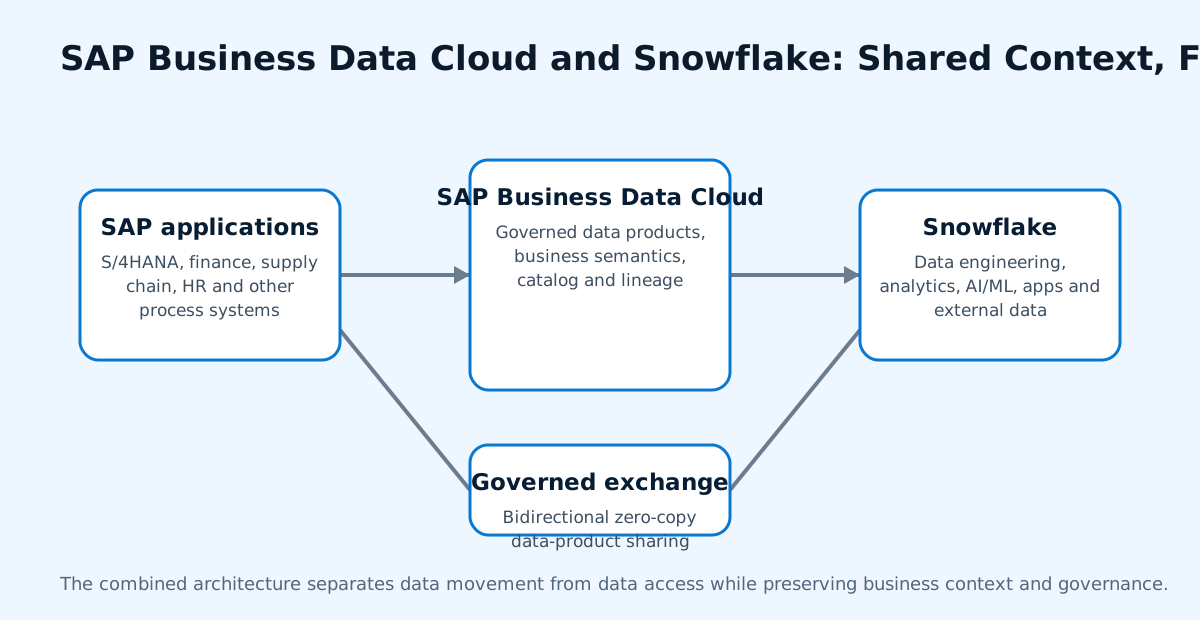
The SAP and Snowflake discussion has moved from competition to architecture
For several years, enterprise data teams were pushed into an artificial choice: keep SAP data inside an SAP-centric analytics architecture or extract it into a hyperscaler, lakehouse or independent data platform. The announcement and 2026 general availability of SAP Snowflake and SAP Business Data Cloud Connect for Snowflake create a more useful question: which platform should provide business context, which should provide data and AI capabilities, and how can the two exchange governed data products without rebuilding another estate of fragile pipelines?
SAP’s current product documentation describes two paths.
- SAP Snowflake is an SAP solution extension within SAP Business Data Cloud for customers that want a fully managed Snowflake capability provisioned through SAP.
- SAP BDC Connect for Snowflake connects an existing Snowflake account to SAP Business Data Cloud.
Both support bidirectional, zero-copy data-product sharing in supported configurations. The architectural value is not simply faster transfer. It is the ability to preserve business context, lineage and governance while data is used across platforms.
From system of record to system of intelligence
A useful executive metaphor from the strategy material is that ERP is a system of record and a modern data platform helps create a system of intelligence.
The metaphor should not be taken literally. SAP systems do more than report the past, and Snowflake does not automatically create foresight. The distinction is about roles.
- SAP applications execute and record business processes.
- SAP Business Data Cloud packages governed business data and semantics as discoverable products.
- Snowflake provides scalable data engineering, analytics, application and AI/ML capabilities across SAP and non-SAP data.
- The combined architecture can return enriched data or insights to the SAP data fabric and business processes.
The value appears when context and compute are connected without losing governance.
What zero-copy data sharing changes
Traditional integration often creates repeated copies: extract SAP data, transform it, load it into another platform, create new semantic models and build separate security and lineage processes. Every copy adds delay, cost and another point where meaning can diverge.
The SAP–Snowflake integration uses governed data-product sharing so that supported data can be accessed without conventional ETL replication between the platforms. SAP documentation emphasizes bidirectional sharing, preservation of business context and the ability to combine SAP-managed data products with Snowflake data and AI services.
Zero-copy does not mean there is never any data movement anywhere in the landscape. Source applications still feed SAP Business Data Cloud, some use cases require caching or replication, and BW data may first be provisioned into the SAP Datasphere object store. It means that the exchange between supported BDC and Snowflake environments can avoid another physical copy for the shared data product.
The two deployment paths
Path 1: SAP Snowflake
SAP Snowflake is relevant when a customer wants Snowflake capabilities as part of its SAP Business Data Cloud arrangement. SAP positions it as a solution extension with unified billing and SAP first-line support. The zero-copy connector is created as part of the provisioning flow.
This path can simplify commercial and support alignment, but it should still be evaluated for region availability, edition, capacity, data residency, security and the operating model between SAP and data-platform teams.
Path 2: SAP BDC Connect for an existing Snowflake account
This path is relevant when the organization already has Snowflake and wants to connect that environment to SAP Business Data Cloud. The customer provisions BDC Connect, establishes the connector in Snowflake and completes the secure enrollment process.
The advantage is continuity: the enterprise can use its existing Snowflake platform, skills, governance and workloads while gaining governed access to SAP data products. The challenge is organizational: SAP and data teams must agree on ownership, access, semantics and support across the shared architecture.
Five architecture principles
1. Business semantics should have an owner
A data product is more than a table. It needs a business definition, owner, quality expectation, access policy and lifecycle. SAP Business Data Cloud can preserve SAP context, but the enterprise still has to decide who is accountable for the meaning.
2. Compute location should follow the use case
Not every workload belongs in the same platform. SAP-centric operational analytics, cross-enterprise data engineering, AI/ML, planning and application workloads may have different needs. The architecture should choose the right execution environment without duplicating the data unnecessarily.
3. Enrich-and-return is more valuable than extract-and-forget
A mature pattern takes governed SAP data into Snowflake, combines it with external or non-SAP data, creates an insight or feature, and publishes a governed result back for consumption in SAP Business Data Cloud or operational processes. That closes the loop between data science and business execution.
4. Governance must span both platforms
Identity, entitlements, lineage, audit, retention, data residency and incident management must be designed end to end. A technically secure connector does not resolve unclear operating responsibility.
5. The business case should remove pipelines, not add another platform
The combined architecture is economically attractive only when it replaces duplication, accelerates delivery or enables high-value use cases. If it adds a new platform while every old integration remains, complexity and cost rise.
Illustrative use cases
The following examples are original sapperment analysis based on the joint architecture. They are not customer claims from the source files.
DSO root-cause analysis
SAP finance data shows which receivables are overdue. Snowflake can combine that governed data with macroeconomic, industry, customer-interaction and external-risk data. A model can identify drivers and produce prioritized actions. The result can be shared back as a governed data product for finance teams or agent-driven collections workflows.
Predictive quality in manufacturing
SAP contains material, production, quality and cost context. Snowflake can combine it with high-volume sensor, MES, maintenance and supplier data. The model can identify patterns that precede defects and return risk scores or recommended actions.
Demand sensing for retail and consumer products
SAP holds orders, inventory and supply data. Snowflake can add point-of-sale, e-commerce, promotion, weather, mobility and market signals. The combined model can improve short-term demand sensing and provide a governed input to planning.
Supply-chain and sustainability risk
Supplier and logistics data can be enriched with external risk, emissions, transport and geopolitical data. The result can support sourcing, inventory and transportation decisions without requiring all external data to be copied into the transactional core.
When should SAP lead, Snowflake lead or the combined architecture lead?
SAP-led
Use SAP-centric services when the primary value is standard business semantics, operational process integration, SAP-managed content or governed analytics close to SAP applications.
Snowflake-led
Use Snowflake as the primary platform when the workload is dominated by diverse non-SAP data, large-scale data engineering, marketplace data, custom AI/ML or data applications already standardized on Snowflake.
Combined
Use the joint architecture when the use case requires both: trusted SAP business context and substantial external data, cross-platform analytics or advanced AI capabilities. The zero-copy connector is most valuable here.
The decision should be use-case specific. “One platform for everything” is usually a commercial slogan rather than an architecture principle.
A governance operating model
A combined platform needs four named roles.
- Business data-product owner — accountable for meaning, quality and permitted use.
- SAP platform owner — accountable for BDC formation, SAP sources, catalog and SAP-side controls.
- Snowflake platform owner — accountable for Snowflake security, compute, data engineering and workload governance.
- Use-case owner — accountable for the business outcome and for decommissioning the previous solution when the new pattern succeeds.
A joint architecture board should approve reusable patterns, not individual ad hoc pipelines. The goal is to make the second use case faster than the first.
A 100-day implementation path
Days 1–20: Select a use case and data product
Choose a use case that requires both SAP and non-SAP data. Define the economic outcome, source data, semantic owner and expected consumer.
Days 21–45: Establish the connector and governance
Choose SAP Snowflake or BDC Connect for an existing account. Complete security, region, identity and formation design. Define access and audit responsibilities.
Days 46–75: Build the enrich-and-return flow
Consume the SAP data product in Snowflake, combine it with the external data and create the output. Publish the result back when the business process benefits from SAP-side consumption.
Days 76–100: Measure and industrialize
Measure delivery time, duplicated storage avoided, pipeline maintenance reduced, model performance and business outcome. Convert the successful design into a reusable reference pattern.
The executive conclusion
The strategic value of SAP Snowflake is not that one platform defeats the other. It is that SAP business context and Snowflake data and AI capabilities can be combined with less data duplication and a more explicit governance model.
That creates choice. It also creates a management obligation: remove redundant pipelines, assign semantic ownership and focus the architecture on outcomes. Without that discipline, zero-copy becomes another feature. With it, the enterprise can turn SAP data from a bounded application asset into a governed input for cross-enterprise intelligence.
Executive takeaway
The decision is not whether to adopt another technology label. The decision is whether the operating model, architecture, governance and value case are strong enough to turn the technology into repeatable business outcomes. That is the standard sapperment applies: separate the vendor promise from the management decision, and make the path to execution explicit.
Frequently asked questions
What is SAP Snowflake?
SAP Snowflake is an SAP Business Data Cloud solution extension that provides managed Snowflake data and AI capabilities with SAP integration, billing and first-line support.
What is SAP BDC Connect for Snowflake?
It is the connection path for customers that already have a Snowflake account and want bidirectional, governed data-product sharing with SAP Business Data Cloud.
Is the SAP–Snowflake connector generally available?
Snowflake announced general availability of the SAP BDC zero-copy connector on 4 May 2026, and SAP documentation lists SAP Snowflake and bidirectional Snowflake sharing as available in supported regions and configurations.
Does zero-copy mean no data is ever moved?
No. It refers to supported sharing between SAP Business Data Cloud and Snowflake without creating another physical copy for the shared data product. Other parts of the source and target architecture may still involve replication or caching.
When is the combined architecture most valuable?
When a use case needs trusted SAP business semantics together with substantial non-SAP or external data, advanced data engineering, AI/ML or data applications in Snowflake.
Related reading and internal links
- Executive Clarity
- SAP BW modernization in Business Data Cloud
- Autonomous Enterprise operating model
- SAP Cloud ERP for Finance
- Shared business context & unified data
- SAP BW modernization in Business Data Cloud
- Andreas BORN — executive author profile
Call to action
Use this article as an executive briefing before your next architecture, transformation or investment decision. For board-level framing, transformation challenge sessions and independent decision support, visit Executive Clarity.
Sources and evidence
- SAP and Snowflake strategy source files supplied by Andreas BORN, including the “system of record / system of intelligence” framing and illustrative cross-data use cases. Internal market-sizing figures and confidential stakeholder material were intentionally excluded.
- SAP Help Portal, “Introducing SAP Snowflake.” https://help.sap.com/docs/business-data-cloud/sap-snowflake/introducing-sap-snowflake
- SAP, “SAP Snowflake.” https://www.sap.com/products/data-cloud/snowflake.html
- Snowflake Release Notes, “May 4, 2026: SAP BDC Zerocopy Connector (General availability).” https://docs.snowflake.com/en/release-notes/2026/other/2026-05-04-Snowflake-SAP-zerocopy-integration
- SAP Help Portal, “Provisioning SAP Business Data Cloud Connect.” https://help.sap.com/docs/business-data-cloud/administering-sap-business-data-cloud/provisioning-sap-bdc-connect
- SAP News Center, “SAP and Snowflake Unleash the Power of Data and Enterprise AI Across the Business Data Fabric,” 4 November 2025. https://news.sap.com/2025/11/sap-snowflake-data-enterprise-ai-business-data-fabric/
Source integrity note
The uploaded Snowflake material is marked internal and includes assumptions, target figures, compensation data and named stakeholders. None of that confidential material is reproduced. Product availability and technical claims were verified against current SAP and Snowflake primary documentation.